Jan 15, 2010
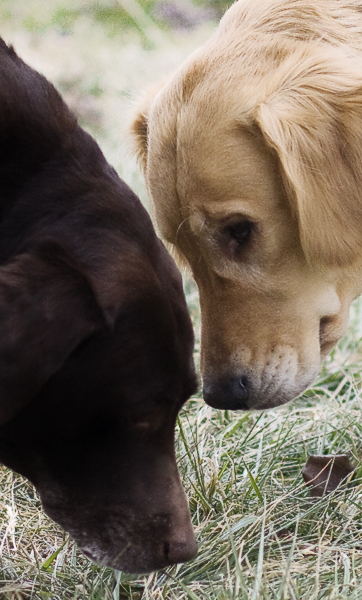 If you’re new to whatifitdid.com, please let me introduce the two sexy girls to the left — Libby and Gracie. Libby came to me in 2001 as a puppy, and Gracie made her home with me in July 2009 as a dog. Libby grew up with attention and affection and Gracie had none.
Although both Libby and Gracie love attention, Libby is confident and assertive. She barks when others invade her space and is self-assured. She exudes boldness and pride as she walks. She’s willing to let Gracie eat first, because she knows without a doubt that she will get hers.
Gracie lacks self-esteem and is a follower. Her every movement is an attempt to get attention or an attempt to ‘fit in’. Her tail is tucked down and although she attempts to do the same things Libby does, she’s constantly seeking approval. She’d push Libby to the curb in a heartbeat if she thought she’d get more favor, and would throw her under a bus if she thought it would make us like her more.
Ok, so they are dogs (don’t tell them, ok?) — but people are the same way, aren’t they? We know that there are people who talk about things they know nothing about and pretend to be an expert so they can ‘fit in’. We also know there are people who criticize, analyze and judge others simply to make themselves feel better or look more important. Now you can choose to get angry with these types of folks and reciprocate by saying ugly things about them, or you can realize that quite possibly there have been issues in their lives that have formed their personalities as such, and they really don’t have a clue what they do is mean and ugly.
The good news is, I’ve seen a huge change in Gracie in the past few months. She’s growing to understand more of who she is. She even wags her tail occasionally, and isn’t quite as needy. I figure that if she can become a better hound dog simply because we curb our frustration and anger when she exhibits rude behavior, maybe the same type of treatment will work on humans too. You think?
Jan 14, 2010
If you’re not one of the lucky people who got a new camera from Santa, and you still want to play along at home with the latest photography posts here — have I got a link for you!
Snapsort will compare cameras side-by-side and give you tons of details! All you do is pick 2 models you’re interested in (possibly based on price), and this tool will tell you which camera rolls out on top.
Jan 13, 2010
I wrote a post a couple days ago to answer a few basic photography questions. I tried to cover those most frequently asked by friends/family that were new to using an EOS digital camera. A bit later a comment was posted, and then my favorite brother on the planet shared the article with his 1500-plus closest friends on FaceBook. That’s when I started getting email in reference to the post. Almost every single comment started with, “I really want to try your suggestion, but I don’t know where to start…” So today I’ll post on shooting photos using Aperture-Priority (Av) –changing the depth of field.
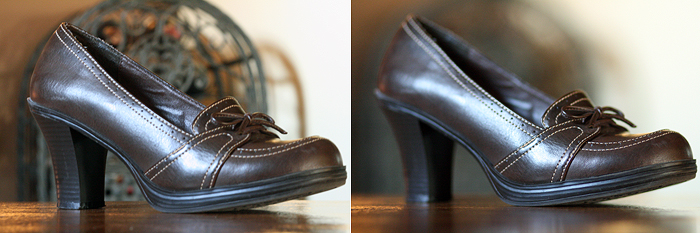
Av stands for Aperture value which is the size of the diaphragm hole inside of your camera lens. Shooting in Av is semi-automatic. It’s really simple and makes such a dramatic difference in the way your photos turn out. So to provide an example, I took off my shoe, and set it on a table:

When shooting in Av, remember the bigger the f/number, the clearer the focus (higher =sharper). In the shoe photo on the left, I’m at f/9.0 — on the right, I’m at f/2.2. You’ll notice in the photo to the right, even the shoe’s heel is slightly out of focus, so you must consider your photo composition before you really get started. Wouldn’t want a headshot with a crispy-clear nose and blurry eyes, would you?
So here’s how you do it…
Set the dial on your camera to Av. While looking at the display, move the dial (the one just above the on/off switch), to change the f/number. Again, start with something around f/2.8. (Different lenses will allow for different apertures, and if no lens is attached, 00 will be displayed.) Now everything else will be automatic.
Make sure you share your thoughts and photos! I’ll post on Shutter-Priorty within the next couple days!
Jan 12, 2010
I’ve had a few jobs in my life that I didn’t like, and I’m pretty happy they are a distant memory. If I’ve learned anything these past couple of years doing a job that I’m passionate about, it’s that flexibility is paramount. When one minute I have ten deadlines, and the next second I have none, and the phone rings, and the Internet goes down, and I work late because I didn’t get everything accomplished I needed to — it doesn’t break me. Every crisis is an opportunity. It’s all in how you look at it…
Jan 11, 2010
Since Christmas, I’ve answered several photography/camera questions via phone and email. It appears that Santa brought new cameras to 80% of those reading whatifitdid.com and to my family/friends. The only thing I can remember from my training some 20-years ago is taking photos of fruit. Like — lots and lots of fruit. It was all about lighting and composition — very important — but was so boring I would’ve rather had a stick poked in my eye.
The last thing I would want is for visitors to get a stick in their eye here on a Monday morning, so I’ll try to keep this brief. I really hope this info is useful or at least interesting to some of you:
1. I shoot in manual mode. It’s really slow to learn at first, and when I first started out, I shot in shutter and aperture priority only, but now it’s natural for me. Like I know if I’m outside and it’s a sunny day in July, I’m going ISO 100, f/2.8, and 1/2000. If it’s a dreary day in January in the burg, and I don’t have much light in the room I’m in, I’m going ISO 3200, f/1.8 – f/2.0, and 1/125. You’ll figure out what works for you — just start playing around. As a rule of thumb, you’ll shoot extremely high ISO’s (1200-3200) in the burg from around October to February, and post-process lighten those images that are a bit too dark.
2. I always, ALWAYS, shoot in RAW (you never know when you’ll get that one awesome photo you want printed as big as the house), and I only use Photoshop and Adobe Camera Bridge to edit photos. If you don’t use these programs for editing software, I’m sorry, I can’t be much help. If you use Bridge, I would suggest you purchase Kubota Adobe Camera RAW Presets — it’s only $20 bucks and well worth the $$.
3. I don’t have a “favorite” lens. For portraits, I love my 85mm 1:18, but if you’re looking for something a little more versatile and cost effective, the 50mm 1.8 ($100) is an awesome lens.
And finally — for those of you with new cameras that want to learn something new (if you don’t know it already), and aren’t quite ready to shoot in manual mode…
- For details and shallow depth of field (quiet moments) – start with Aperture Priority. Set your lens to around 2.8 and let your camera do the rest.
- For energetic and action shots, head outside and try Shutter Priority. Start with 1/300 or 1/500 and let your camera do the rest.
- Don’t forget to share your comments/photos as you try AP and TV modes!